
Has the Employee Market Ended in Poland?
June 2, 2026
Article
Analysis of the Polish Labor Market in 2026
For many years, experts, media outlets, and employers repeated the same phrase: "We have an employee-driven market." Low unemployment, a record number of job vacancies, and a shortage of candidates allowed job seekers to choose from multiple offers and negotiate increasingly attractive employment conditions.
However, recent years have brought significant changes. High inflation, economic slowdown, rising labor costs, the development of artificial intelligence, and changing migration patterns have raised an important question:
Has the employee market in Poland come to an end?
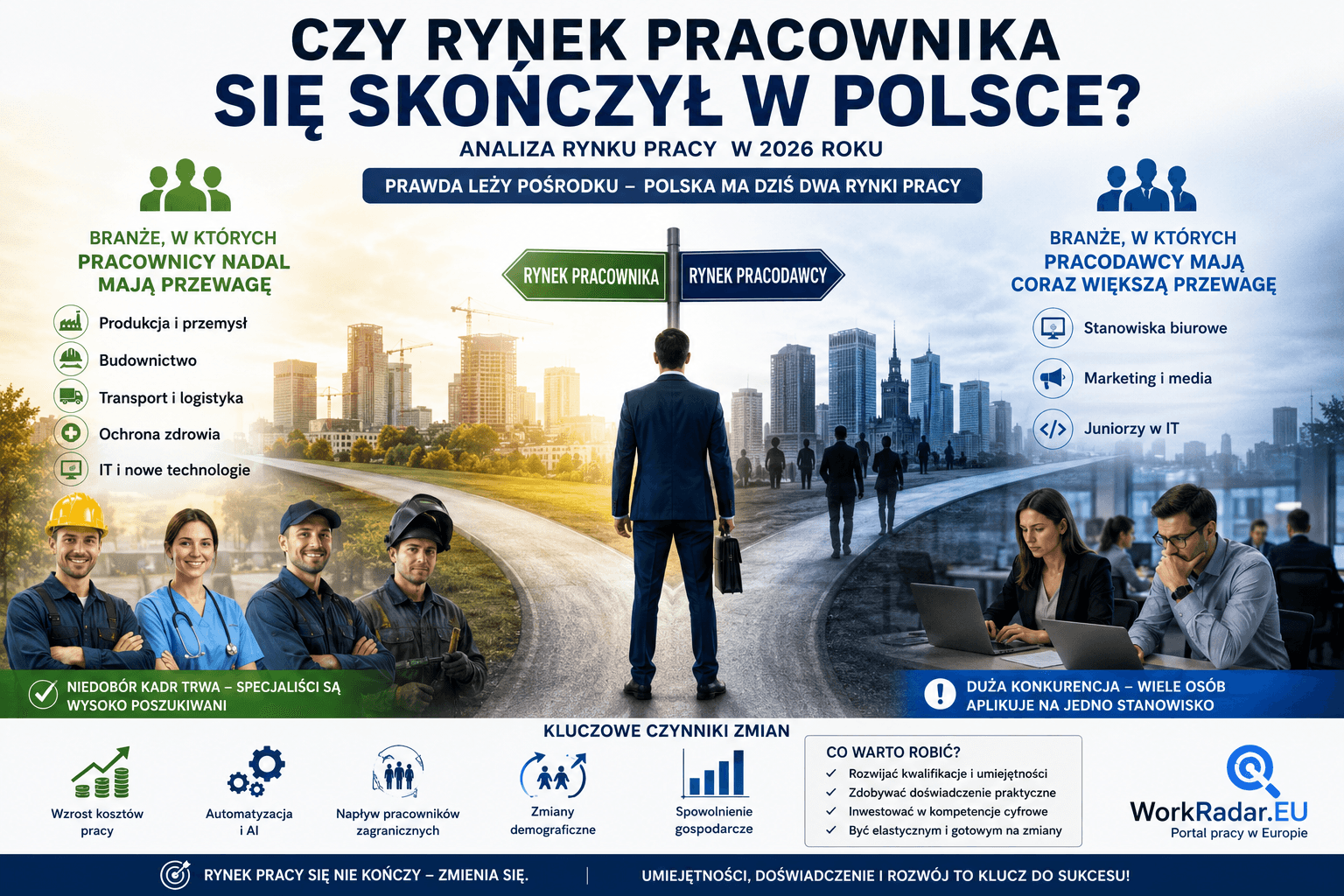
The answer is not straightforward. In reality, Poland currently stands somewhere between an employee-driven and an employer-driven market, and the situation largely depends on the industry, qualifications, and location.
What Has the Polish Labor Market Looked Like Between 2022 and 2026?
In 2022–2023, Poland was among the countries with the lowest unemployment rates in the European Union. Companies were actively looking for workers, and labor shortages were one of the biggest challenges faced by businesses.
The largest shortages were observed in:
- Manufacturing
- Logistics
- Construction
- Transportation
- Healthcare
- Hospitality and tourism
In many regions, employers competed for candidates by offering higher wages, bonuses, and additional benefits.
The situation began to change during the economic slowdown observed in 2024–2025. Some companies reduced investments, decreased recruitment activities, or implemented workforce restructuring.
Nevertheless, this did not result in a dramatic increase in unemployment. Poland continues to maintain one of the lowest unemployment rates in Europe, while many industries still struggle with labor shortages.
Why Are More People Talking About the End of the Employee Market?
1. Fewer New Recruitment Processes
Many industries have seen a decline in job postings compared to the post-pandemic period.
Employers have become more cautious and increasingly:
- Freeze vacancies
- Extend recruitment processes
- Analyze labor costs more carefully
While several years ago companies often hired ahead of demand, today they focus on candidates who precisely match their current needs.
2. Rising Labor Costs
Regular increases in the minimum wage and higher business operating costs have made companies more cautious about expanding their workforce.
This particularly affects:
- Small businesses
- Retail
- Service industries
- Hospitality
3. Automation and Artificial Intelligence
An increasing number of business processes are being automated.
This includes:
- Customer service
- Administration
- Accounting
- Marketing
- Basic office work
Companies are investing more frequently in AI-based solutions that enable tasks to be completed faster and more cost-effectively.
This does not mean mass job losses, but it does increase competition for administrative and office positions.
Which Industries Still Favor Employees?
Despite recent changes, labor shortages remain significant in many sectors.
Manufacturing and Industry
Polish industry continues to face shortages of:
- Machine operators
- Welders
- Metalworkers
- Electricians
- Maintenance technicians
In many factories, finding a qualified specialist can take several months.
Construction
Construction remains one of the most labor-deficient industries.
The most sought-after workers include:
- Bricklayers
- Reinforcement workers
- Carpenters
- Structural assemblers
- Construction equipment operators
Infrastructure and industrial investments continue to generate strong demand for workers.
Transportation and Logistics
Transport companies continue to report shortages of professional drivers.
There is also strong demand for:
- Warehouse workers
- Forklift operators
- Logistics center employees
Healthcare
Staff shortages in healthcare remain among the most severe in Europe.
Particularly in demand are:
- Nurses
- Medical specialists
- Elderly caregivers
- Physiotherapists
IT and New Technologies
Although job growth in IT is no longer as dynamic as it was several years ago, experienced specialists continue to enjoy attractive employment opportunities.
The highest demand exists for professionals skilled in:
- Cybersecurity
- Data analytics
- Artificial intelligence
- Cloud computing
Where Is the Employer Market Becoming Stronger?
Office Positions
Administrative and office jobs currently attract a large number of applicants.
A single vacancy may receive dozens or even hundreds of applications.
Marketing and Media
The growing popularity of remote work has significantly increased competition for marketing positions.
Junior IT Roles
A few years ago, companies actively hired entry-level IT professionals.
Today, many employers expect practical experience, making it more difficult for newcomers to enter the industry.
The Impact of Foreign Workers
The Polish labor market increasingly relies on foreign workers.
The largest groups come from:
- Ukraine
- Belarus
- Georgia
- Moldova
- Nepal
- India
- Bangladesh
- Philippines
- Sri Lanka
- Central Asian countries
For many businesses, international recruitment has become a necessity.
Without foreign workers, many manufacturing, logistics, and construction companies would struggle to maintain operations.
At the same time, the influx of foreign workers increases competition for some lower-skilled positions.
Demographics Favor Employees
One of the most important factors influencing the future of the labor market is demographics.
Poland has been facing:
- Low birth rates
- An aging population
- A shrinking working-age population
As a result, even with slower economic growth, companies will continue to need new employees.
This demographic trend makes a complete return to a fully employer-driven market unlikely.
Forecast for 2026–2028
The most likely scenario is continued segmentation of the labor market.
Easier Employment Prospects For:
- Technical specialists
- Manufacturing workers
- Drivers
- Machine operators
- Construction workers
- Professionals with AI-related skills
More Difficult For:
- Unskilled candidates
- Administrative workers
- Entry-level office professionals
- Individuals with only basic digital skills
Practical competencies and continuous professional development will become increasingly important.
Conclusion
Has the employee market ended in Poland?
No.
However, its nature has changed.
Today, Poland can be described as having two labor markets at the same time. In some professions employees still hold the advantage, while in others employers have gained stronger negotiating power.
For candidates, success increasingly depends on qualifications, practical skills, and adaptability.
For employers, effective recruitment strategies and workforce development remain essential.
One thing is certain: the competition for qualified workers in Poland is far from over.