
Where in the EU Can You Save the Most Money? Salary vs. Living Costs
October 16, 2026
Organizer
Organized through: WorkRadar.RU
Article
A high salary does not always mean more money in your pocket. When choosing a country to work in, it is important to compare not only net earnings but also the cost of accommodation, food, transport and other essential expenses.
For workers planning to move abroad, the key question is simple: How much money will remain at the end of the month?
Salary is only part of the equation
Countries such as Luxembourg, Germany, the Netherlands, Belgium and Ireland offer relatively high wages in many occupations. However, housing and everyday expenses can significantly reduce the amount workers can save.
Meanwhile, Central and Eastern European countries generally have lower living costs, but wages are also lower. The most financially attractive destination therefore depends on the balance between earnings and expenses.
Three figures are particularly important:
- Gross salary: earnings before taxes and contributions.
- Net salary: take-home pay after applicable taxes and contributions.
- Disposable income after living costs: the amount remaining after essential monthly expenses.
What determines your potential savings?
| Expense | What to check |
| Accommodation | Monthly rent, utilities and possible wage deductions |
| Food | Realistic grocery budget |
| Transport | Commuting costs and employer-provided transport |
| Other essentials | Phone, hygiene and everyday necessities |
Accommodation often makes the biggest difference. An employer offering genuinely free housing and transport may provide a better financial outcome than an employer offering a higher hourly rate but leaving all expenses to the worker.
Which countries should you compare?
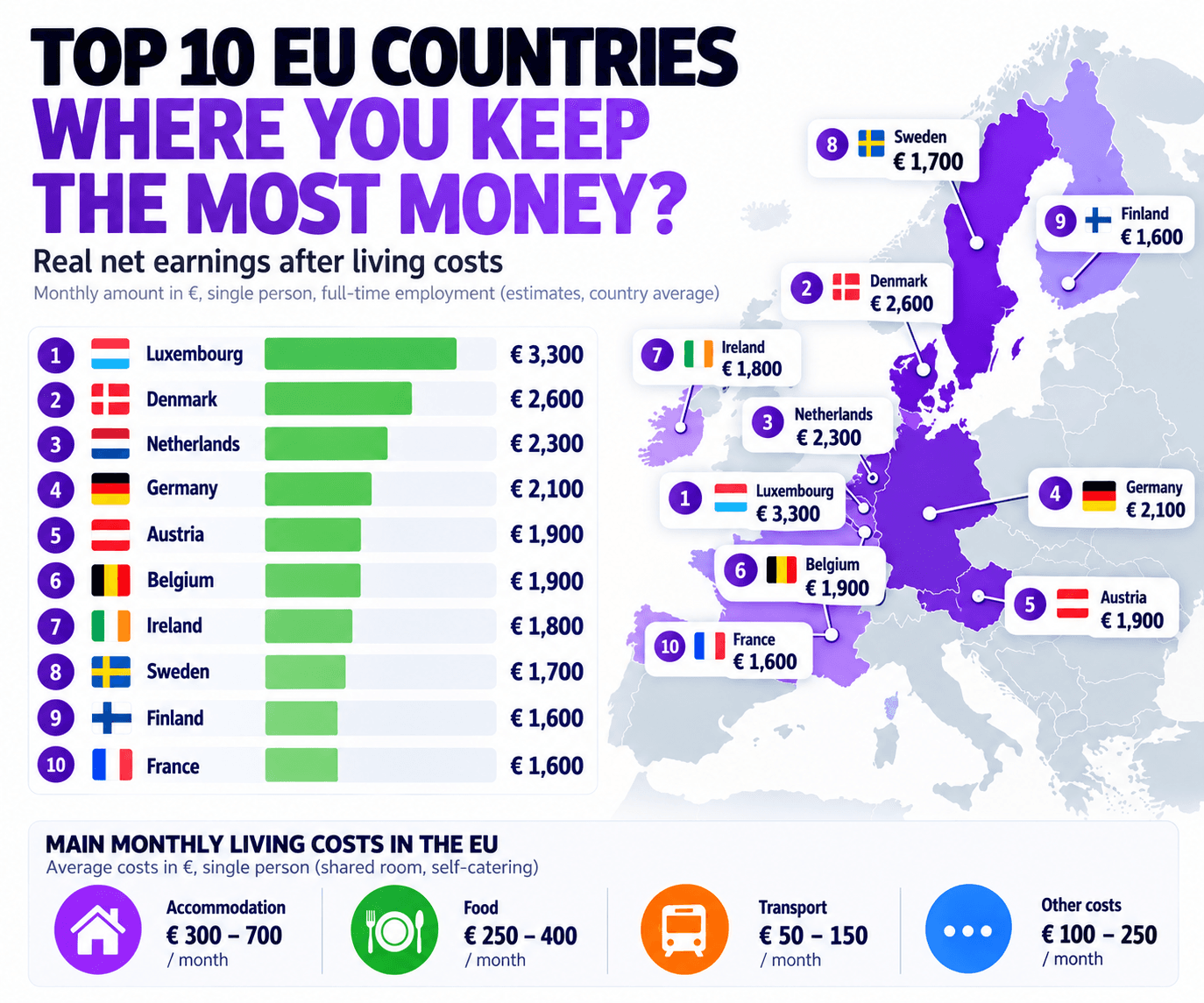
Luxembourg, Germany, the Netherlands, Denmark, Belgium and Ireland are worth examining for their wage opportunities. Austria, Sweden, Finland and France also offer employment opportunities across various industries.
However, no single ranking applies to every worker. Results vary by occupation, region, qualifications, tax situation and accommodation arrangements. National average salaries alone cannot establish where workers save the most.
Your occupation matters
Welders, CNC operators, electricians and fitters may have different earning opportunities from production and warehouse workers. Experience, certifications, shift allowances and guaranteed working hours can all affect monthly income.
When comparing vacancies, check the expected net salary, actual working hours, accommodation charges and transport arrangements. Do not assume that advertised overtime or bonuses are guaranteed.
How to calculate what you can save
Use this simple formula:
Net monthly salary − accommodation − food − transport − other essential expenses = money remaining.
For example, a worker earning €2,200 net with €1,200 in monthly expenses would have €1,000 remaining. A worker earning €2,500 net but spending €1,700 would have the same amount left.
These figures are illustrative, not country-specific averages.
Find opportunities across Europe
Before accepting a job abroad, compare the complete employment offer rather than focusing only on the advertised wage. Confirm all deductions, accommodation conditions and guaranteed hours.
Explore vacancies across Europe on WorkRadar.eu and evaluate opportunities based on both earnings and living costs.
The best job is not necessarily the one with the highest salary. It is the one that offers the best balance between income, expenses and working conditions.